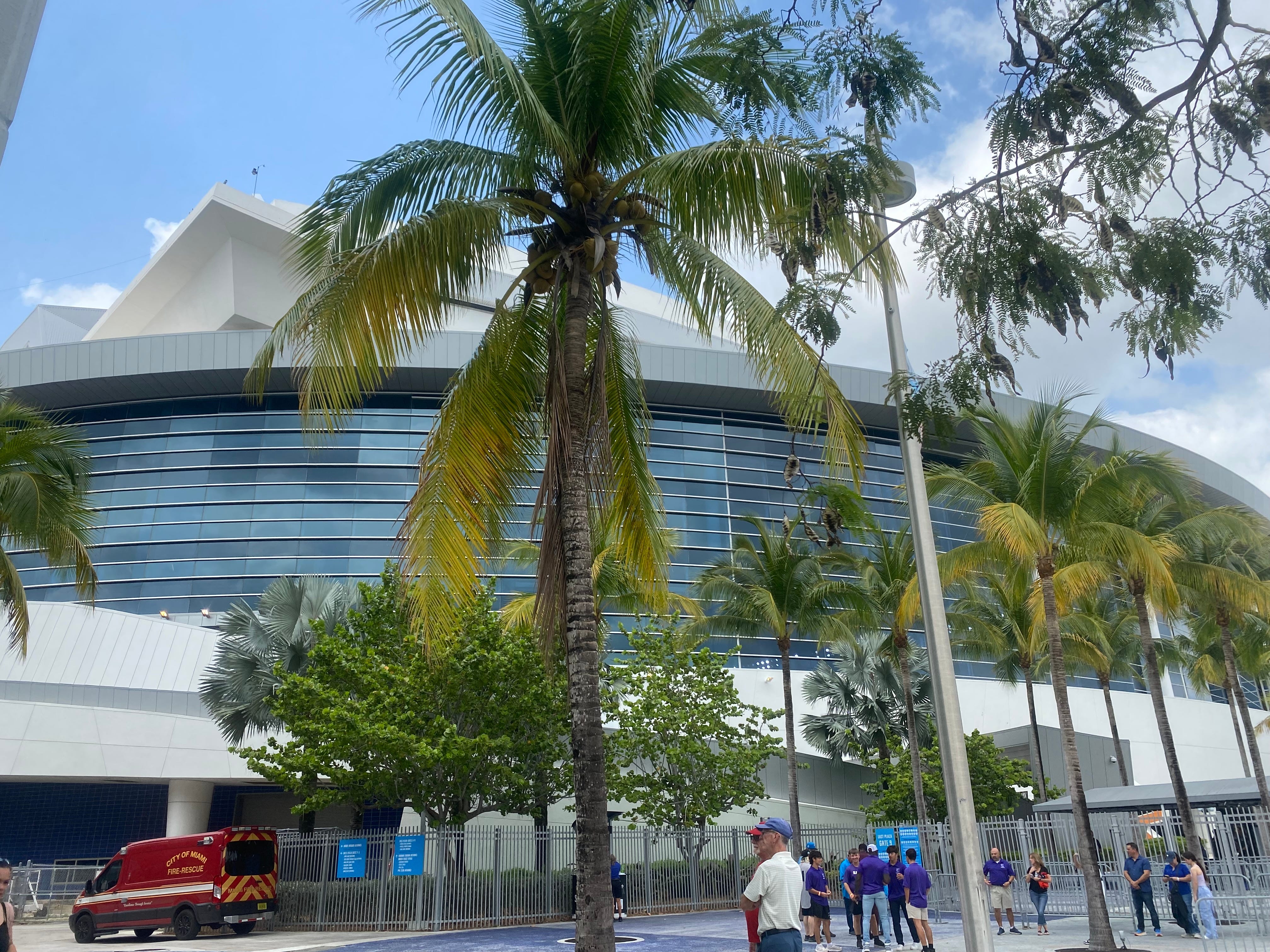
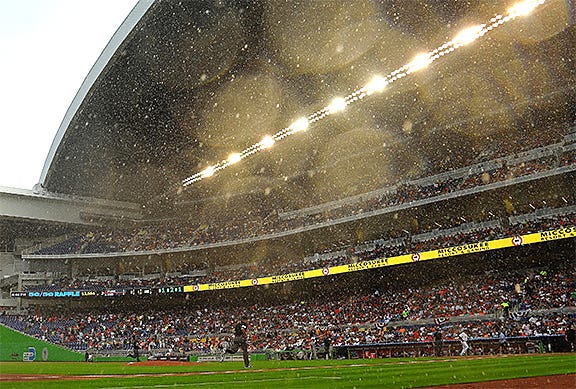
Remember the rain delay at Marlins Park, you know, where there’s a retractable roof?

For years, I’ve been writing about baseball rain delays. Weird, huh?
More specifically, I’ve written hundreds of stories and thousands of words about how weather events have plagued baseball games throughout the game’s history.
One of the more unusual weather events I’ve researched happened a little more than a decade ago when the Miami Marlins experienced a rain delay on Opening Day of the 2015 Major League Baseball season.
So, why was this rain delay unusual?
Because Marlins Park, as it was called then, was built four years earlier with a retractable roof, specifically to avoid those pesky pop-up Miami thunderstorms that can ruin a day at the ballpark.
That’s right. The stadium roof could be closed – at the touch of a button – if there was a threat of rain. A short heads-up to a potential threat was all that was needed.
A few years ago, I talked on the phone with then-Marlins President David Samson about what transpired that day. He took a lot of stick from the media for relying too heavily on weather apps to predict the severity and direction of approaching storms. In our brief conversation, Samson took full responsibility for the blunder and talked about the “horrific” phone call he had to make to his boss, Marlins’ owner Jeffery Loria when Samson realized there would be a weather delay.
Below is an excerpt of our chat from May 25, 2016. (My questions are in bold.) To start, I asked Samson what he remembered most about the rain delay. He paused for about two seconds, signed, and began talking.
“It was extremely surreal when I realized we were going to have a rain delay in a retractable roof facility, and I was the one responsible. And it was Opening Day.
How were you responsible?
At the end of the day, when bad things happen, it’s my fault, and when good things happen, it’s because of someone else. I knew that the roof was open, and I didn’t think the rain was coming. I looked at my cell phone; I looked at three different weather apps, and I did not think we were going to be impacted and neither did the people around me.
And then all of a sudden, it started raining and then raining harder. And, I just remember thinking, it’s not going to rain harder, but then it rained even harder. And then I remember the umpires getting together and realizing that we were about to have a rain delay.
Are you the only person making the decision to close the roof?
It’s not just me. Of course, there are other people involved, but it’s my responsibility to make sure that the roof is closed when it’s going to rain.
How much did it rain?
It wasn’t a lot of rain, but quick. It was a quick rain delay. I want to say it was about a 40-minute rain delay at most. It was quick. It could have been much worse, but the level of embarrassment was significant.
And then one of our players actually slipped running to first base, Dee Gordon. On what would have been an infield base hit, he slipped coming out of the box because it was wet. And, we lost the game. I don’t remember a lot of games because I’ve been in baseball 17 years, but I remember that game.
Just because of the rain delay?
Yes.
If I remember correctly, the rain delay was in the second inning, and Dee Gordon slipped in the eighth. So, was it that wet?
So, it’s a great question, right? Revisionist history would tell you that it’s because it rained, that he slipped because it rained. I would tell you that it’s possible he could have slipped on a sunny day. But, because it was a rain delay, it enabled people to draw that conclusion, including myself.
I read that when you realized it was going to rain, you had a conversation with Marlins’ owner Jeffrey Loria and told him you were going to have a rain delay. He said, “I thought we had a roof.” Is that correct? Did that conversation happen?
That’s exactly what happened, but your timing is a little off. I called him as soon as the umpires were talking, and I said to him, “We’re about to have a rain delay.” And it was a horrific phone call to make. I used to have to make those phone calls when we were at Dolphins Stadium. And those were everyday calls I used to make to him saying “Rain delay is coming” or “It’s going to rain, we’re starting again in an hour.” That was an everyday thing. But in the new ballpark it didn’t even occur to us, that was year four in the new ballpark, and it had just never, ever occurred to either me or him that I would ever be making those calls again.
But I did make the call and, he did say to me, “I thought we had a roof.”
Was there anything else he said that you can share with me?
No. I’d say that was pretty much the end of the conversation. I said, “I’m sorry.” He hung up, and I hung up, and that was it.
What was the aftermath like?
It got a lot of attention, obviously, and… No, I was very careful to avoid him for the next 24 to 48 hours. (He said this with a laugh.)
Was he at the ballpark?
Of course he was. I was up in a suite, and he was sitting next to the dugout. In the rain.
Do you now consult with meteorologists or are you still using weather app?
We do consult with a meteorologist, but we still use weather apps. We’re just much more conservative now.
How so?
If there’s even the hint of a cloud, we’ll start closing the roof. (He laughed.)
Who are the meteorologists? Are they employed by the Marlins?
No. It’s individual ones (meteorologists) from around town. And the weather service.
Did you have a tarp?
We did have a tarp (at the time of the rain delay), but it was in a place that’s not readily accessible. It’s near the field, but it’s not on the field. So, it would have been a difficult process to get the tarp put up over the infield. And the reason I approved having the tarp in an out-of-the-way storage place is I said there’ll never be an issue with rain because we have a roof.
Is it more accessible now?
No. We still have it in the same place. The only thing that’s changed is me.
How so?
I’m just more conservative about the weather.
How did you deal with the negative media attention? It seems you had a pretty good sense of humor about it.
Yes, of course. I did a press conference that day. There was so much media wanting to know what was going on. Listen, no lives were lost. No one’s lives were in danger. No one got hurt. So, I don’t ever pretend that we’re doing something to human life or liberty. We’re an entertainment company. So, I tried to make it entertaining in how I reacted to it, but obviously, I take it very seriously, and I was very disappointed, but publicly, my stance was to be more jocular.
What was the fan reaction?
Most of it was humorous.
In what forms? Mostly social media?
Some people brought umbrellas to the next game, or they would wear a hooded sweatshirt or raincoat. Whenever I was out in a restaurant or giving a speech somewhere, people would walk up to me or tell me about their rain shoes that they now wear to the ballpark, that sort of stuff.
People are still doing that a year later?
It’s cut down. People remember it. I was at a speech this week that I gave where it came up, but it does not come up nearly as much as it used to.
How long does it take to close the roof?
Between 11 and 15 minutes, depending on the wind.
What’s the process, mechanically? Do you just press a button?
It’s literally a button, yes.
Who presses the button?
We have special button pushers. (He joked.) They are part of the stadium operations group, and their job is to run the mechanical roof.
Did you hear much back from the field crew after this?
What are you going to do? They were as unhappy as I was.
What is the daily process of deciding to close the roof for a game?
We look at temperature. We look at wind speed. We look at wind direction. We look at humidity, relative humidity and rain chance. And we make a decision based on all of those factors.
How soon ahead of game time do you make the decision?
I would say around four hours before game time, so 3 o’clock for 7 o’clock game.
How do you inform the public?
Just our social media.
How unpredictable are these South Florida rainstorms?
That’s what squalls are. Squalls, meaning the weather is fine, and all of a sudden it’s a thunderstorm, and then it’s fine again. These things just sort of pop up. That’s the dangerous part. It just happened to happen at a bad time.
Any other close calls since then?
No. (He laughed)
What did you learn most from this experience?
I should keep galoshes in my office.
You still don’t? (I was joking)
Yes, now I do because you never know.